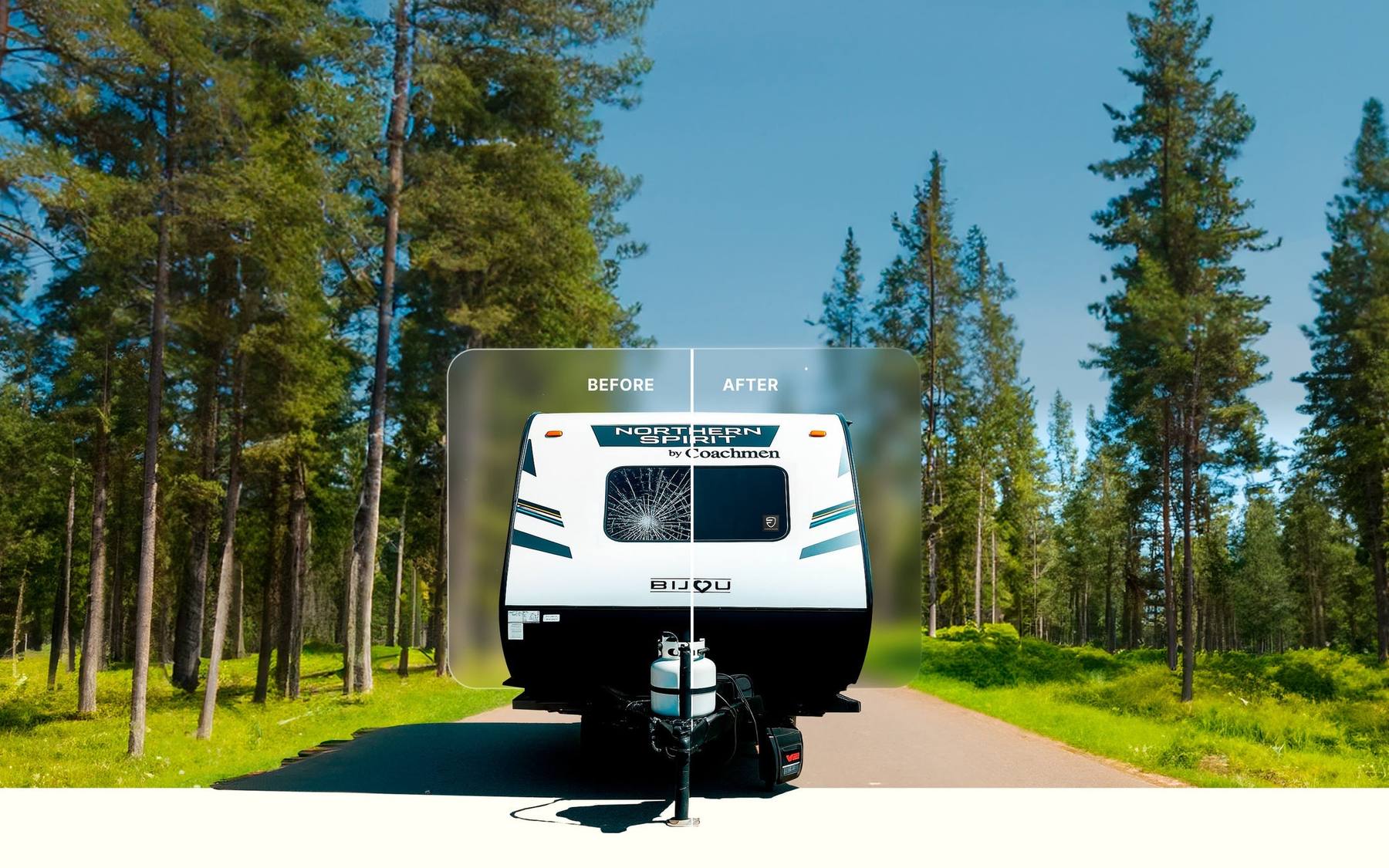
Fifth wheel windshield covers aren't sized by trailer length — they're sized by front cap geometry, which varies wildly between manufacturers and even between model years from the same brand. A 32-foot Forest River and a 32-foot Keystone may have front caps that differ by 18+ inches in cover dimensions.
This guide walks through how to measure correctly, the dimensions that actually matter, and which brands tend to share platform geometry so you know what to expect.
TL;DR
- Trailer length doesn't determine cover size — front cap geometry does
- Three measurements matter: windshield width, windshield height, A-pillar wrap depth
- Most fifth wheel windshields fall into 4 size brackets (compact, mid, large, XL)
- Brand pattern sharing is real — Forest River uses similar caps across multiple sub-brands
- Custom-fit is the only way to guarantee proper coverage for non-standard models
What's actually different about fifth wheels
Fifth wheel front windshields are larger and more variable than motorhome windshields because:
- No structural cab requirement — manufacturers can shape the front cap freely
- Aerodynamic trends vary by year (early 2010s = boxy, late 2010s = swooping curves, 2020+ = aggressive aero)
- Side windows often integrate with the front cap, requiring a wraparound cover
- Vertical front-cap walls vs angled = different windshield profile
A typical fifth wheel windshield is 60-90 inches wide and 25-40 inches tall. Beyond that, it varies by manufacturer, year, and floorplan.
Three measurements that matter
To buy the right cover (or to verify a custom-build), measure these three:
1. Windshield width
Measure the WIDEST part of the windshield, edge to edge, on the outside surface. Don't include the side cab windows yet — just the windshield itself.
Typical range: 60-90 inches.
2. Windshield height
Measure from the top of the windshield (where it meets the roof line) down to the bottom (where it meets the front cap trim or hood). Take this measurement at the CENTER of the windshield, not the edges.
Typical range: 25-40 inches.
3. A-pillar wrap depth
On most fifth wheels, the windshield curves slightly into the side cab area. Measure how far the cover should extend past the windshield onto the A-pillar trim or side window.
Typical range: 3-12 inches.
Size brackets we use at FIT
We've grouped fifth wheel windshields into four size brackets based on the dimensions above:
Compact (under 32 ft trailer length)
- Windshield: 60-70" wide × 25-30" tall
- Examples: Forest River Wildwood, Keystone Cougar Half-Ton, Coachmen Apex Nano
- Cover dimensions: ~70" × 32" with 6" A-pillar wrap
Mid (32-36 ft trailer length)
- Windshield: 68-78" wide × 28-34" tall
- Examples: Forest River Cherokee, Keystone Bullet, Jayco Jay Flight
- Cover dimensions: ~78" × 36" with 8" A-pillar wrap
Large (36-42 ft trailer length)
- Windshield: 76-86" wide × 32-38" tall
- Examples: Forest River Cedar Creek, Keystone Avalanche, Jayco Eagle 5th Wheel
- Cover dimensions: ~86" × 40" with 10" A-pillar wrap
XL (42+ ft trailer length, luxury models)
- Windshield: 82-90" wide × 36-42" tall
- Examples: Forest River Riverstone Legacy, Brinkley I-275, Coachmen Brookstone
- Cover dimensions: ~90" × 44" with 12" A-pillar wrap
Brands that share front-cap geometry
A few brand families share front-cap molds across sub-brands. If you can identify which family yours is in, the cover for one model often fits another:
Forest River family
Forest River produces Wildwood, Cherokee, Salem, Flagstaff, Rockwood, Cedar Creek, Sierra, and many more sub-brands. Within each size class, they often share front-cap molds. A cover for a Cherokee 32-foot will frequently fit a similar-length Salem.
But — Cedar Creek (luxury) does NOT share with Wildwood (entry-level), so size class matters.
Keystone family
Keystone makes Cougar, Avalanche, Montana, Bullet, Sprinter, Outback, and others. The Montana (luxury) has its own mold; the lower-tier brands (Bullet, Cougar Lite, Outback) share more.
Jayco family
Jay Flight, Eagle, Eagle HT, North Point. Eagle and Jay Flight have largely shared front caps; North Point (luxury) is its own.
What "custom-fit" means for fifth wheels
A custom-fit cover starts with a CAD pattern of your specific year/model's front cap. The pattern accounts for:
- Exact windshield dimensions (with manufacturer tolerances)
- A-pillar wrap depth to match the curve of the cap
- Side window integration if your model has windows that extend forward
- Vent and AC clearance if your front cap has accessories above the windshield
- Bottom edge profile — flat, curved, or sloped into the gas-strut hood line
We've CAD-mapped 60+ fifth wheel and travel trailer models. If yours isn't in the catalog, we custom-build using your VIN and 3 measurements you can take in 10 minutes.
How to verify a fit before installation
Before you install the cover for the first time:
- Measure twice — verify the cover dimensions match your measurements within 1"
- Test-fit dry without magnets — drape the cover over the windshield to check coverage
- Verify edge alignment — corners reach corners, top hits roof line, bottom hits hood
- Check A-pillar wrap — cover extends past windshield onto trim by 6-12"
- If anything looks off — contact us BEFORE marking magnet positions; we'll send a replacement cut
When universal "fifth wheel" covers fail
You'll see "fifth wheel windshield cover" sold on Amazon for $80-$150. They're typically sized for a generic mid-bracket trailer — fits OK on a 32-34 foot Forest River Cherokee, fits poorly on anything else.
The three failure points:
- Width gap — universal covers are typically 70-72" wide. A large fifth wheel (78"+ windshield) has 6-8" of glass exposed at the corners.
- Height gap — universal covers are typically 32-34" tall. A taller windshield has the bottom edge exposed.
- No A-pillar wrap — universal covers have a flat edge; they don't curve onto the side cap, leaving UV bleed paths.
These are the three reasons custom-fit becomes essential at the larger end of the size scale.
Measuring the bottom edge profile
This is the part most owners miss. Fifth wheel windshields meet the front cap in different ways:
- Flat bottom — windshield meets a flat horizontal trim piece
- Sloped bottom — windshield meets an angled cap that slopes forward
- Curved bottom — windshield curves into a rounded cap
Cover bottom edges are cut to match. A flat-bottom cover on a curved-bottom rig will gap at the corners.
Quick way to identify yours: stand 10 feet from the front of your trailer at eye level. Trace the bottom of the windshield with your eye:
- Stays horizontal? Flat bottom.
- Slopes downward toward the wheel wells? Sloped.
- Curves inward like a smile? Curved.
Tell us when you order or use the Custom Fit form so we cut the right profile.
See fifth wheel covers by manufacturer → Custom Fit form →
FAQ
Can I use a 36-foot fifth wheel cover on a 32-foot fifth wheel? Probably not. The 4-foot length difference usually correlates with different front cap molds. The 32-foot cover would either gap or sag depending on the mismatch. Always measure rather than buying by trailer length.
Do all Forest River fifth wheels use the same cover? No, but many sub-brands within Forest River share front-cap molds. Wildwood, Cherokee, and Salem in similar sizes often share. Cedar Creek, Sandpiper, and Riverstone (luxury tier) have their own molds.
How accurate do my measurements need to be for a custom-fit cover? Within ±1 inch is acceptable for our pattern designers. We add tolerance to the cut, so a 1" measurement error won't ruin the fit. Larger errors (2"+ off) will show up as gaps or excess fabric.
Can I install a fifth wheel cover by myself? Yes for most sizes up to 86" wide. Above that, a helper makes installation faster (one person holds one corner, the other lifts the opposite corner), but solo install is still doable in 5 minutes once magnets are placed.
Does the cover have to wrap around the side windows? Only if your fifth wheel has integrated side cab windows that flow off the front cap. Most do — the cover should cover the windshield AND wrap 4-12 inches onto each side. Verify your model's geometry.
What if my fifth wheel has a slide-out near the front cap? Typically not an issue — slide-outs are usually on the side walls, not the front cap. If your slide does touch the front cap area when extended, install the cover with the slide retracted (you'd never run with it extended in storage anyway).