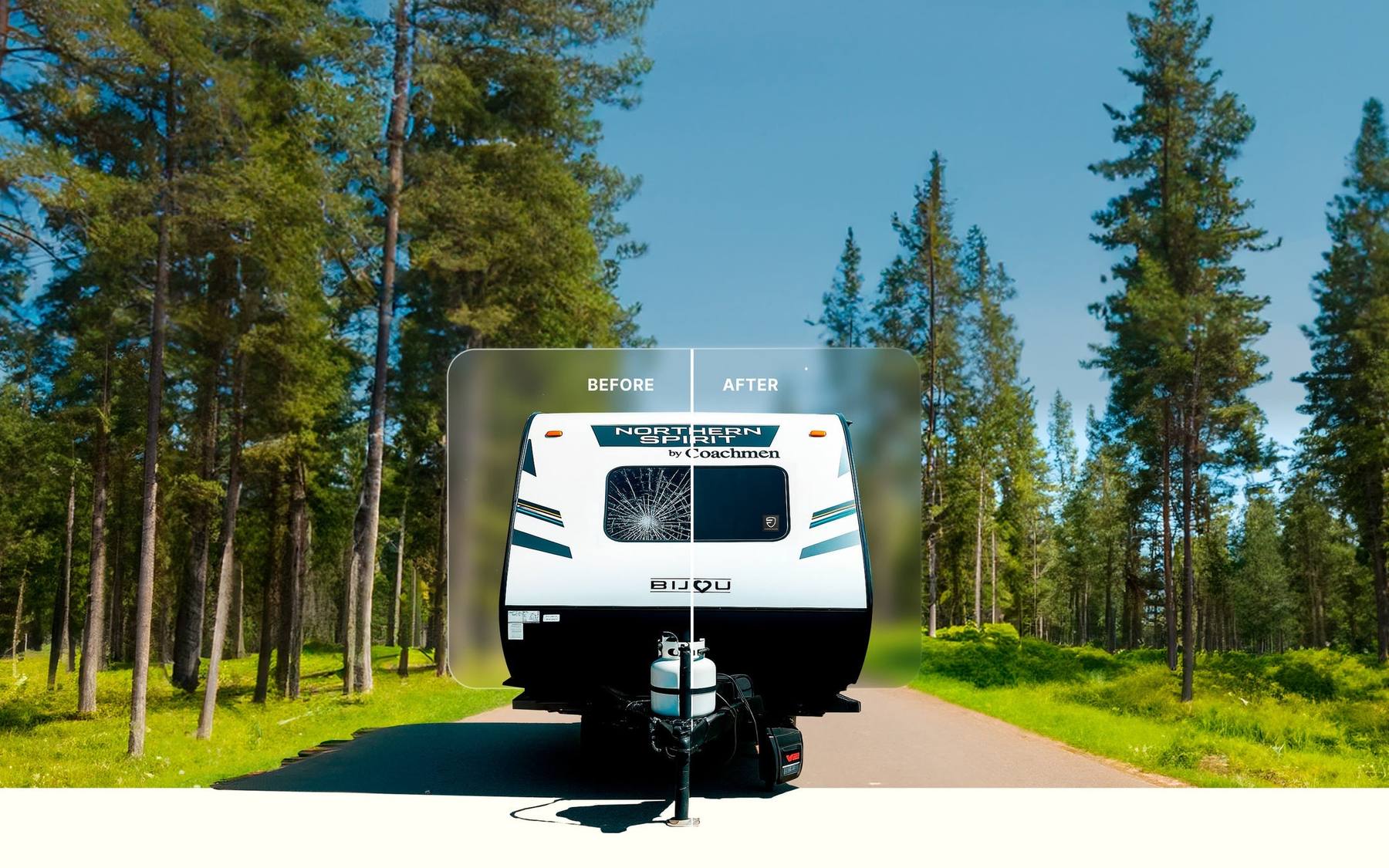
Stress cracks in an RV windshield don't come from rocks or impacts — those are chip cracks, and they radiate from a clear point of impact. Stress cracks usually start at a corner of the glass, run in a straight or gently curved line, and have no obvious origin. They're the result of mechanical stress in the glass itself, caused by changes in the surrounding frame.
Three forces drive almost every stress crack on a motorhome:
- Frame flex during travel (twisting forces on the front cap)
- UV-driven gel-coat shrinkage (the front cap pulling tighter against the glass over years)
- Uneven cabin heating (sun on one side of the windshield, shade on the other)
If you're seeing stress cracks now, you've already accumulated years of these forces. The question is whether you stop the cycle or let it crack a second time after replacement.
TL;DR
- Stress cracks ≠ impact cracks. They have no point of origin.
- Frame flex, gel-coat shrinkage, and thermal cycling are the three causes
- Replacing the glass without addressing the cause = same crack within 18–36 months
- A UV-block windshield cover stops 2 of the 3 causes (shrinkage and uneven heating)
- The third (frame flex) requires inspection of mounting bolts and front-cap condition
Type 1: Frame flex during travel
Class A motorhomes flex more than people think. A 36-foot coach traveling over expansion joints, broken pavement, or even mild weight shift can produce 0.5–1.2° of twist in the front cap. Most of that flex is absorbed by the chassis, but some transfers to the windshield frame.
The glass is bonded to the frame with urethane. Urethane is rigid in a way that doesn't compensate for fast frame movement — when the frame twists faster than the urethane can flex, the stress shows up in the glass. Repeated cycles fatigue the glass at the corners (where stress concentrates) and a crack develops.
Signs frame flex is your cause: - Crack appears after a long highway trip, especially over rough roads - You hear creaking or popping noises from the front cap during travel - Visible gaps in the trim around the front cap - Front-cap fiberglass shows hairline cracks at the corners
The fix: - Check all front-cap mounting bolts for torque (often loosened from vibration) - Inspect for fiberglass delamination at the cap-to-body joint - Replace urethane if the existing bond is older than 8 years and crumbly
Type 2: UV-driven gel-coat shrinkage
This is the most common cause of stress cracks on motorhomes 5+ years old, and the most preventable.
Fiberglass front caps have a gel-coat outer layer that protects the resin underneath. UV degrades the gel coat over time, causing it to shrink slightly (millimeters, but consistent). As the gel coat shrinks, it pulls the surrounding fiberglass cap inward — which compresses the windshield frame and squeezes the glass.
The glass is rigid; the cap shrinks; something has to give. Usually that's a stress crack starting at a top or bottom corner and running diagonally.
Signs UV shrinkage is your cause: - Crack started spontaneously, no recent travel - Front cap shows chalky white surface (oxidized gel coat) - Crack runs diagonally from a corner - Multiple stress cracks have appeared over a 1–3 year window
The fix: - A windshield cover blocking 99%+ UV stops further gel-coat damage immediately - Existing oxidized gel coat can be polished and resealed to restore some elasticity - After the next replacement, a cover used consistently prevents recurrence
Type 3: Uneven cabin heating (the silent crack-maker)
This one surprises most owners. When the rig is parked at an angle to the sun, half of the windshield can be 80–100°F hotter than the other half. Glass expands when heated; when one side expands and the other doesn't, internal stress builds up.
You don't see it happen, but you'll often discover the crack the next morning when you start the rig and the AC blows cool air across the windshield — that's the moment the cracked-but-still-intact glass finally fails visibly.
Signs uneven heating is your cause: - Crack appeared overnight, no impact, no travel - Rig was parked half in sun / half in shade - Crack location matches the dividing line between sun and shade - Multiple cracks appear in the same general area on different occasions
The fix: - A windshield cover eliminates the differential entirely (whole windshield stays the same temperature underneath) - Park the rig in full sun OR full shade if a cover isn't available - Avoid running the AC blast directly at one half of the windshield
Once you have a stress crack, what next?
Three options, in order of cost:
1. Resin-fill repair (under 6", cheap, temporary)
A windshield repair tech can inject UV-cured resin into the crack. This stops it from spreading short-term and is invisible from outside. Cost: $80–$180. Lifespan: 12–24 months before the same crack reopens or a new one appears.
Use this when: - Crack is < 6" - It's not in the driver's primary line of sight - You'll be replacing the rig within 2 years anyway
2. Glass replacement WITH cause-fix
Replace the glass AND address the underlying cause (frame inspection, UV shrinkage prevention, etc). Cost: $2,800–$8,500 depending on rig class. Lifespan: 8+ years if cause is fully addressed.
Use this when: - Crack is in the driver's line of sight or > 12" - The rig has years of life left in it - You're committed to using a cover going forward
3. Glass replacement WITHOUT cause-fix
Just replace the glass and hope. Cost: same as option 2. Lifespan: 18–36 months before the same crack reappears.
This is what most owners do. It's why we see customers come back to FIT after their second windshield replacement — the cover is what breaks the cycle.
How a cover specifically prevents stress cracks
A full-coverage UV-block windshield cover addresses two of the three causes directly:
- UV shrinkage: 99%+ UV blocking stops gel-coat degradation in its tracks
- Uneven heating: the cover keeps the entire windshield at the same temperature (ambient), eliminating thermal differential
For frame-flex prevention, the cover doesn't help directly — but a cover plus consistent post-trip inspection of front-cap bolts handles 95%+ of stress-crack causes.
What to look for in a stress-crack-prevention cover
- Full corner coverage — many covers leave the corners of the windshield exposed. The corners are where stress cracks start. A FIT cover wraps fully past the windshield onto the A-pillar trim.
- UV-block vinyl, not basic polyester — only marine-grade UV-block vinyl provides 99%+ blocking
- Thermal-reflective inner layer — keeps the glass from heating up under the cover
See FIT covers for your model → How the patented mount works →
FAQ
Are stress cracks covered by RV insurance? Comprehensive insurance generally covers windshield replacement regardless of cause, but you'll pay your deductible (typically $500–$2,000). Some insurers will deny claims if they classify it as "wear and tear" — getting a glass tech to write the diagnosis as "stress crack from frame movement" is usually accepted.
How fast does a stress crack spread? A 4" stress crack can grow to 14–20" over a single 300-mile drive on rough pavement. They grow geometrically with vibration and thermal cycling. If you have a fresh crack, minimize driving until you get it filled or replaced.
Can I drive with a stress crack in my RV windshield? Legally varies by state. A crack longer than 6" in the driver's primary line of sight is unsafe and may be a citation in inspection states. It's also a risk that the crack spreads catastrophically during driving, especially over potholes.
Will my stress crack come back after replacement? Yes, in most cases, within 18–36 months — unless you address the underlying cause. The most common cause is UV-driven gel-coat shrinkage, which a quality windshield cover prevents entirely.
Is there a way to repair a stress crack without replacing the whole windshield? Cracks under 6" can be filled with UV-cured resin for $80–$180. This is a temporary fix (12–24 months) but useful if the rig is near end-of-life or if you can't replace right away. Cracks longer than 6" almost always require full replacement.
How long do RV windshields last when properly protected? A windshield with consistent cover use typically lasts 15–20+ years before any stress-related damage. Without protection, average is 5–9 years before the first stress crack appears.