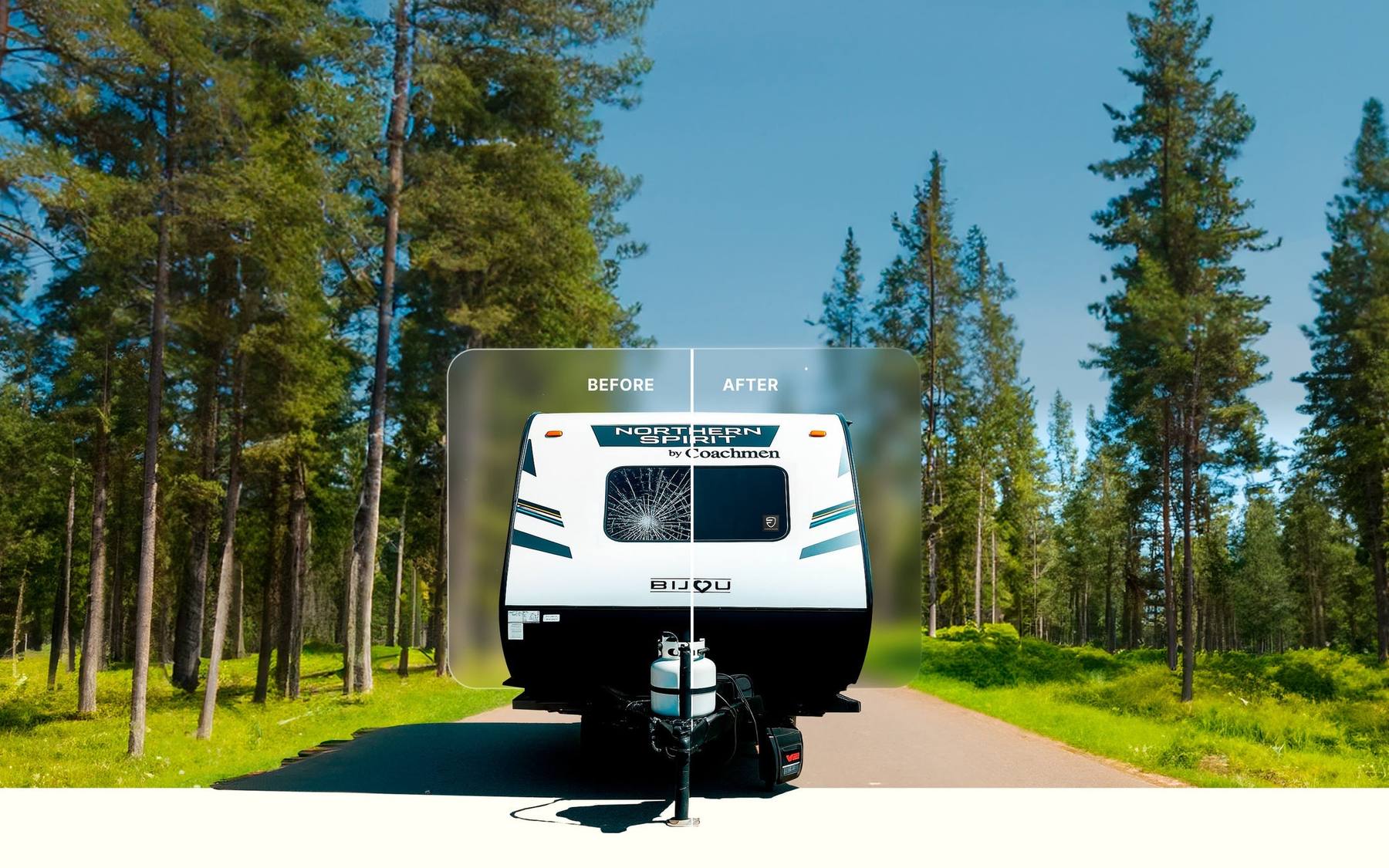
Snowbirds park their RVs for 6+ months a year — and most of the damage they discover in the spring happens during storage, not on the road. Three causes dominate:
- UV exposure — even winter sun degrades dashboard plastic and front-cap gel coat
- Condensation cycling — water vapor inside the cover (if not breathable) cracks window seals
- Rodent and insect damage — covers left improperly become mouse highways
This checklist is what experienced snowbirds use to come back to a rig that looks like they just parked it.
TL;DR
- Cover the windshield — UV doesn't take winter off, and condensation needs a breathable cover
- Inspect the cap — cracked gel coat lets water freeze and expand
- Set rodent deterrents — mothballs and dryer sheets work; ultrasonic repellers don't
- Lift the wipers — sticking wipers tear cover material
- Drain or treat the AC — moisture inside the cover can drip onto the dashboard
- Document the rig — pre-storage photos protect against insurance disputes
Step 1: Pre-storage clean
Before the cover goes on, the windshield and front cap need to be clean. Three reasons:
- Bug splatter held against the glass for months becomes etching damage
- Salt residue from highway driving accelerates oxidation
- Tree sap hardens into a permanent stain after 30+ days
Wash the front cap and windshield with mild soap. Dry completely. Don't let water sit between the cover and glass for the entire winter.
Step 2: Inspect the seals
Walk around the windshield perimeter and check the urethane seal. Look for:
- Cracks or gaps — water gets in during winter and freeze-expands, cracking the cap
- Loose trim — wind during storage can flap loose trim and worsen the gap
- Discoloration — yellow or brown urethane is degrading and may need replacement
If you see any of these, address before storage. A $50 tube of RV urethane sealant is far cheaper than a $4,000 cap repair after winter expansion damage.
Step 3: Set the wipers off the glass
This step is often skipped and causes major cover damage.
If the wipers are pressed against the windshield when you install a cover, the cover material gets pinched between the wiper blade and glass. Over the winter, the wiper blade rusts and stains the cover, and on removal in spring you find a 6" rusted streak across the cover.
Solution: lift each wiper arm OFF the glass before installing the cover. They'll sit pointing into the air, which is fine — they're parked, not running. Restore them in spring.
Step 4: Install the cover
A breathable, UV-blocking, custom-fit cover is critical for long-term storage. Three reasons:
- UV blocking — winter sun is weaker but cumulative; 6 months of weak UV equals 2 months of summer UV in damage terms
- Breathability — moisture inside the cabin needs to escape; a non-breathable cover traps condensation
- Custom fit — a cover that flaps in winter wind tears within weeks; a snug fit doesn't
For snowbird storage specifically, FIT covers are built for long-term storage in hot, humid, and high-UV climates where rigs sit for 4–7 months. The marine-grade UV-block vinyl is breathable enough that interior condensation escapes naturally.
Step 5: Set rodent deterrents
This is non-negotiable in any climate. Mice find RVs in storage and they cause damage that's expensive to fix.
What works: - Strong-scent dryer sheets placed near every potential entry (vents, slides, basement doors). Replace every 30-60 days if possible. - Mothballs in basement bays (don't use inside the living area; the smell takes weeks to clear) - Steel wool stuffed into known entry holes (mice can't chew through it) - Peppermint oil cotton balls at all corners
What doesn't work: - Ultrasonic repellers — mice acclimate within 7-10 days - Glue traps — they catch mice but don't deter them; new mice keep coming - Empty dryer sheets — must be the strong-scent variety, fragrance fades
Step 6: Drain or treat the water systems
Water in lines freezes and cracks pipes. Standard winterization:
- Antifreeze in fresh and waste tanks (RV-grade pink, not automotive)
- Open all faucets to relieve pressure
- Drain water heater if not bypassed
- Disconnect city water hose from the rig
This is RV 101 but it's what people forget under storage stress.
Step 7: Document the rig
Take photos of: - The full exterior at storage time - Each side, front, and back - Close-ups of any existing damage or wear - Tire tread depth (insurers ask) - Storage location and date
If something happens during storage (theft, weather event, fire), you'll need this documentation for insurance. The 5-minute photo session pays back massively if you ever file a claim.
Storage location matters
The same rig in different storage situations has wildly different damage outcomes:
| Storage type | UV risk | Rodent risk | Climate risk | Cost |
|---|---|---|---|---|
| Heated indoor garage | None | Very low | None | $400-$800/mo |
| Unheated indoor | None | Low | Low | $200-$500/mo |
| Carport / partial cover | Moderate | Moderate | Moderate | $80-$200/mo |
| Open lot, paved | High | High | High | $40-$120/mo |
| Open lot, gravel/dirt | High | Very high | High | $20-$80/mo |
Where you can't control the storage type, the cover does the most work. A premium cover on an open-lot storage performs roughly equivalent to no cover on a covered-carport storage.
Spring de-storage checklist
When you come back to your rig in spring:
- Remove rodent deterrents before opening doors (the smell will pour out)
- Inspect for evidence of mice (droppings, chewed wire insulation) — early detection prevents real damage
- Reset the wipers onto the glass
- Remove the cover carefully — fold and store, don't drag on pavement
- Inspect the cover — replace if you see UV degradation, fabric tears, or magnetic backing damage
- Wash the front cap — winter dust and tree sap accumulate even under a cover
- Pressure check the seals — especially around the windshield where freeze-thaw cycles happen
Common storage damage we see in spring
These are the top issues snowbirds report when they uncover in spring:
- Faded dashboard — caused by UV through uncovered windshield or insufficient UV blocking
- Mouse-chewed cover — cover left without rodent deterrents
- Stress crack in windshield — caused by uneven cabin heating during occasional warm winter days
- Mildew under cover — cover wasn't breathable; condensation accumulated
- Wiper stain on cover — wipers weren't lifted before cover install
A custom-fit FIT cover with proper rodent deterrents and pre-storage prep avoids all five.
What about winter UV in northern climates?
Even Minnesota gets UV in winter. The angle is lower, the days are shorter, but cumulative exposure over 5-6 months still causes measurable dashboard damage. UV index of 2-3 in winter × 180 days = roughly 360 UV-day-units, equivalent to 30 days of summer UV.
For owners storing in northern climates, the cover stays on for the full 5-6 months and prevents the cumulative damage.
See FIT covers by model → Long-term storage care guide →
FAQ
Should I cover my RV with a tarp instead of a windshield cover? A full-rig tarp protects everything but doesn't breathe — moisture trapped underneath causes mildew, seal damage, and paint problems. Better solution: a breathable windshield cover for the front + a full-rig breathable cover (more expensive) or just careful storage planning.
Can I store my RV outside if I have a quality windshield cover? A windshield cover protects the front cap and windshield only — it doesn't protect the roof, sides, or tires. Outdoor storage is fine but expect cumulative wear on uncovered surfaces over 5+ years.
How often should I check my RV during long-term storage? At minimum monthly. Look for rodent evidence, leaks, and tire pressure. A quarterly walkaround inspection catches most issues before they become major.
Will a windshield cover prevent ice from forming on the windshield? The cover prevents direct ice formation on the glass, but condensation can still form between the cover and the glass in extreme conditions. Generally not an issue if the cover is breathable.
Can rodents chew through a magnetic cover? Mice can chew through fabric of any kind given enough motivation. The defense is rodent deterrents (dryer sheets, mothballs) inside the rig, not cover material. Mice rarely chew the cover itself if they can find easier entry points.
How long does a windshield cover last in long-term storage conditions? A premium UV-block cover used for 5-6 months a year (snowbird pattern) typically lasts 7-10 years. Year-round storage rigs see 5-7 years before fabric replacement is needed.